
Colleton Projected Release Date Meaning
The South Carolina Department of Corrections labels its public field Projected Release Date. SCDC describes it as the projected date when all incarcerated terms will be satisfied, based on sentence type and continued work, education, and good-time credits at the present earning rate. The agency also calls it a maxout date. It can change.
Several nearby dates answer different questions. Projected Parole Eligibility signals possible eligibility or sometimes a scheduled hearing date. A Board grant authorizes parole subject to conditions. Physical departure records when the person actually leaves. Community supervision may continue after that departure. Final discharge marks the later end of the applicable sentence or supervision.
| Date or event | Meaning | Proof source |
|---|---|---|
| Projected Release Date | Changing SCDC maxout estimate | Current SCDC detail |
| Projected Parole Eligibility | Possible parole eligibility or hearing date | SCDC and Board records |
| Actual release | Physical end of that custody episode | Releasing agency record |
| Discharge | End of sentence or supervision obligation | SCDC or SCDPPPS record |
Lookup Colleton SCDC Projections
Begin at the SCDC inmate-search disclaimer, accept its terms, and continue to the current-inmate search. Search by SCDC ID, SID, first name, or last name. Phonetic name matching is available. Select the correct person and inspect the detail fields for the exact Projected Release Date label.
The current tool reports people sentenced to and incarcerated in SCDC, with data as of midnight the previous day. It excludes released people, county-only detainees, people on parole or probation, other community-supervision cases, juveniles, and categories the interface identifies. No match cannot prove release.
- Confirm that the person is in SCDC custody, not solely in the Colleton jail.
- Search by SCDC ID or SID when possible; otherwise match the full name and personal details.
- Open the detail and record the Projected Release Date exactly as displayed.
- Record the lookup date because sentence and credit data can change.
- Keep Projected Parole Eligibility separate from the maxout projection.
- After the projected day, check the released list, VINE, and supervision record for actual events.
The SCDC current search shows its detail fields and glossary.
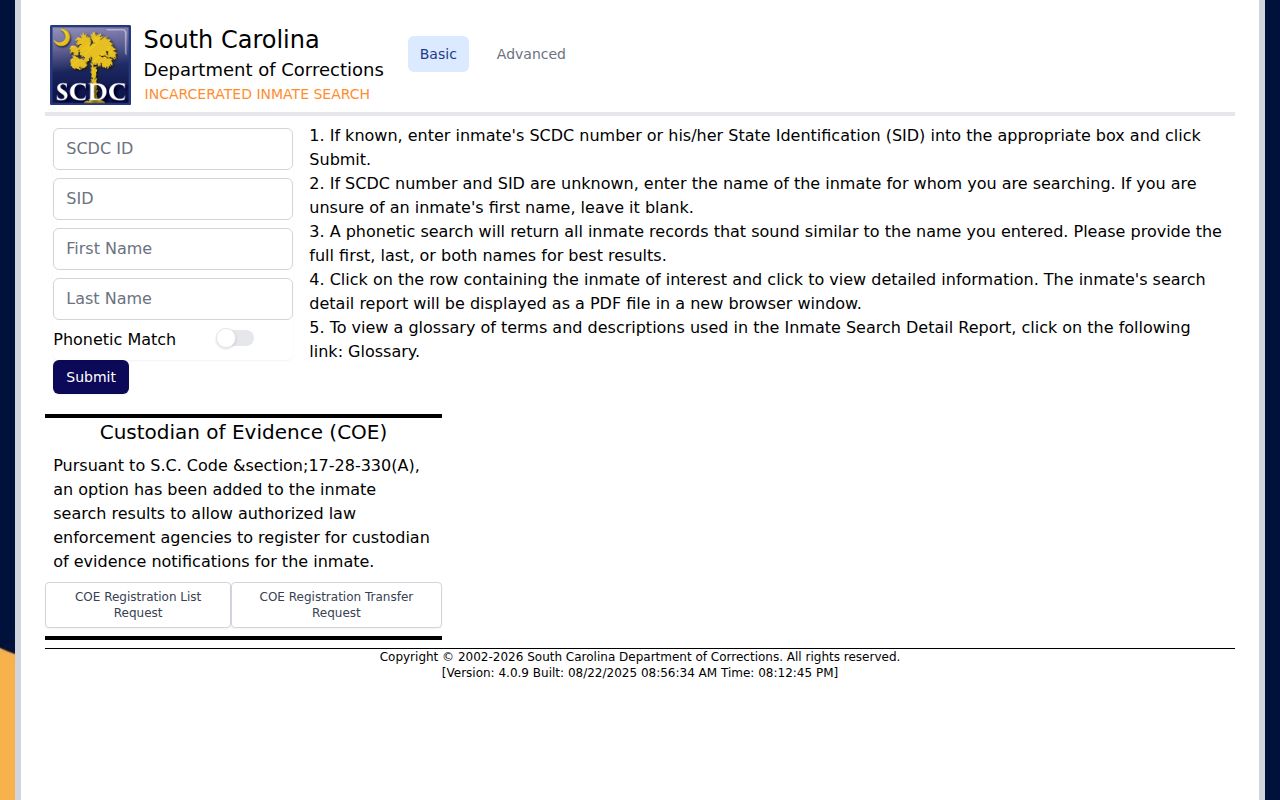
The image documents the current-prison lookup. It is not a historical release locator and does not certify that the person left on the projected day.
Why Colleton Release Projections Change
SCDC sentence computation combines the sentence length, sentence start date, verified prior-service or jail credit, earned credit, and lost or forfeited credit. The public projection assumes that future credits continue at the present rate. That assumption can stop being true.
Work or education participation may change. A disciplinary finding or escape may prevent earning for a period or cause a credit loss. Colleton or another county may later verify qualifying prior custody, which can correct the sentence start. A court can amend sentence data. Concurrent terms served together and consecutive terms served one after another also affect the result.
- Verified jail credit can change the starting computation.
- Good-conduct credit can be earned or forfeited.
- Work and education participation can begin, pause, or end.
- A court may amend a sentence or commitment record.
- Another hold or sentence can prevent physical departure.
A change in an underlying fact may not move the displayed date at once. The remaining sentence, credit level, and update timing all matter. Do not calculate a guaranteed date from a screenshot.
Colleton Sentence Credit Rules
South Carolina Title 24, Chapter 13 sets different credit structures by custody and offense type. A qualifying SCDC inmate serving an offense other than a statutory no-parole offense can earn twenty days for each month served through good conduct. A qualifying SCDC inmate serving a no-parole offense can earn three days per month, without reducing service below the statutory floor.
Local detention follows another rule. A person sentenced to a county facility or county public works may earn one day for each two days served if conduct qualifies. This is the relevant statutory starting point for an eligible Colleton local sentence. It does not apply to every pretrial detainee, and it must not be replaced by the SCDC twenty-days-per-month formula.
The same chapter permits the SCDC director to award qualifying work or education credit. For a non-no-parole inmate, that can range from zero to one day per two days employed or enrolled, with combined credits capped at 180 days in a year. A qualifying no-parole offender may receive six days per month, capped at 72 days annually. The statute says the director may award credit. Future awards are not guaranteed.
The South Carolina corrections and sentence-credit law shows these distinctions.
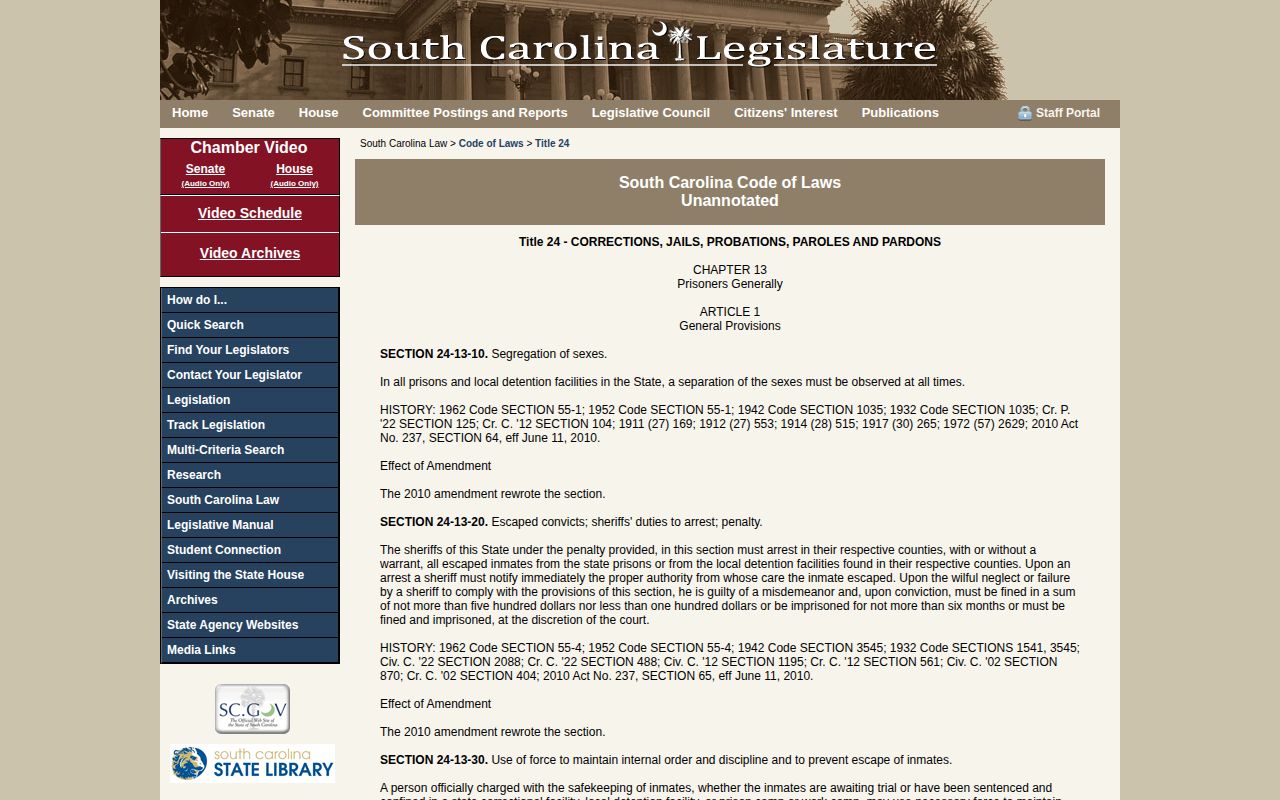
The law explains possible inputs to the official computation. It is not a substitute for SCDC’s person-specific calculation or the Colleton jail’s local ledger.
- Good-conduct credit
- A statutory deduction earned through qualifying conduct and subject to forfeiture.
- Work or education credit
- A discretionary credit for qualifying SCDC participation within statutory caps.
- Concurrent sentences
- Terms that run at the same time under the controlling judgment.
- Consecutive sentences
- Terms served one after another and aggregated for computation.
Colleton 85 Percent Rule
The often-repeated 85-percent rule is narrower than it sounds. Section 24-13-100 defines a “no parole offense” through statutory classifications and penalty terms. It does not mean every felony, every violent offense, or every Colleton County detainee must serve 85 percent.
Under §24-13-150(A), a person convicted of a statutory no-parole offense and sentenced to SCDC custody cannot receive early release, discharge, or qualifying community supervision until serving at least 85 percent of the actual term imposed. That percentage is calculated without earned work, education, or good-conduct credits. Credits cannot push service below the floor.
The rule applies to the unsuspended prison term actually imposed. It does not create release eligibility where murder or another law independently bars it. It can reach an SCDC-sentenced person housed in an authorized local designated facility, but it is not the general rule for ordinary local jail sentences.
A 365-day year governs sentence and time-served calculations under §24-13-175. Even with that rule, hand calculations remain unreliable because sentence start, prior custody, multiple terms, forfeitures, amendments, and holds require authoritative records.
Note: Ask SCDC which statute and sentence data control the displayed projection instead of assigning the 85-percent rule from the charge name alone.
Colleton Jail Release Calculations
The Colleton County Detention Center does not use SCDC’s public Projected Release Date field for a county-only sentence. Ask the jail for the commitment or sentence, credit for time served, qualifying good-conduct ledger, any forfeitures, and the actual release calculation. The Detention Center information line is 843-549-5742.
Pretrial custody is also distinct from a sentenced local term. A bond hearing or release order may authorize departure, but the jail must still verify identity, process paperwork, check holds, and complete transfer or release steps. A court date is therefore not a projected jail exit time.
Colleton County Detention Center22 Klein Street
Walterboro, SC 29488
Phone: 843-549-5742
Fax: 843-549-4321
If formal documentation is needed, request the existing sentence calculation and release record through the Sheriff’s FOIA channel. The agency should be asked for records it maintains, not required to create a fresh projection or explain a calculation it does not possess.
Colleton Release Versus Discharge
For qualifying no-parole sentences, §24-21-560 requires SCDC to notify SCDPPPS of the projected release date 180 days before release, or at once for a sentence of 180 days or less. The person may then enter mandatory community supervision before the sentence is fully discharged.
That creates at least three possible milestones: the public SCDC projection, actual departure from prison, and later discharge from supervision. A supervision violation or another lawful hold can also affect what happens next. Use the Colleton County parole and probation record to verify community status after an SCDC release.
A county release can likewise be a transfer rather than community return. The Colleton portal’s Held For Agency field may identify another jurisdiction. Call the jail and search that receiving agency before describing someone as free from custody.
Confirm Colleton Actual Release Dates
When the projected date arrives, use the system that owns the custody episode. For SCDC, search the separate Released Inmate Search by date range and county. Then use SC VINE and SCDPPPS if notification or supervision continues. For discrepancies, SCDC directs inquiries to Ombudsman@doc.sc.gov; historical records can be requested through FOIA@doc.sc.gov.
For Colleton County jail custody, search the official portal by exact Release Date. That public result shows a calendar date but not release time, release reason, releasing authority, or destination. Call the Detention Center or request the custody and release sheet for those existing fields.
The court docket can support the legal basis for release, such as a sentence, bond order, or later amendment. It cannot prove the exact gate time. Likewise, an SCDPPPS result can prove supervision after departure but not the moment SCDC or the jail ended custody. Match each event to its record owner.
When a projected date passes with no release result, first check for an updated projection and confirm the person’s current location. A forfeited credit, amended term, consecutive sentence, detainer, or transfer can explain the difference. Ask the agency for its present computation rather than treating the older date as an error.
Keep proof in sequence: official projection, actual release record, receiving-agency check, supervision record, and discharge. This prevents a projected maxout, parole hearing, or vanished roster entry from being mistaken for completed release.
Search Public Records
Sponsored Results